
Virtual Try-On
How to Choose Jewelry as a Gift: Ring Size, Style and Seeing It on Them
Start with what they already wear. Their jewelry tells you the metal they like, the size they wear and how bold they go, and matching those three things is most of the job. Then pin down the size without giving the surprise away, and if you can, look at the piece on a photo of them before you pay.
This guide takes each step in turn, starting with the one people search for most: finding a ring size without asking.
Read their jewelry box first
- Metal: if almost everything they wear is yellow gold, or silver, or rose gold, stay with it. Mixed-metal wearers give you more room.
- Scale: someone who wears small studs and a fine chain every day is unlikely to wear a statement piece, and the reverse is true too.
- Everyday or occasion: a piece they can wear daily usually gets worn more than one saved for events.
- Metal sensitivity: if they avoid cheap jewelry or only wear one metal, a nickel allergy may be the reason. Platinum, titanium, higher-karat yellow gold and nickel-free sterling silver are safer choices than plated or costume pieces; some white gold alloys contain nickel.
- Piercings: check that their ears are pierced, and how many holes, before you buy earrings.
How to find her ring size without her knowing
The most accurate way is to measure a ring she already wears on the same finger. Borrow it for a few minutes and lay a millimeter ruler across the inside, edge to edge: that is the inner diameter, and our ring size chart converts it to US, UK, EU, Japanese and Indian sizes. You can also print the chart's circles at actual size and match the ring to the circle that lines up with its inner edge.
- Use a ring from the right finger. The same finger on the other hand can be a different size, so be sure which finger the new ring is for.
- If you can't take the ring away, trace the inside edge on paper with a sharp pencil. A jeweler can estimate the size from a clean tracing.
- Ask someone who knows: a close friend or relative may already know her size, or can find out while shopping with her.
- If you have to guess, the ring size chart lists the most common sizes: US 5 to 7 for women, with US 6 the most popular, and US 8 to 10.5 for men.
- Between two sizes, choose the larger one. A ring that is a little loose can be worn while you arrange a resize; one that is too small can't be worn at all.
Check whether the ring can be resized
A plain gold, silver or platinum band can usually be made larger or smaller by a jeweler, so a guess is not final. Some rings can't be resized easily, or at all: eternity bands with stones all the way round, many tension settings, and rings made of tungsten or titanium. For those, the size has to be right before you buy, and the seller's exchange policy matters more than usual.
Necklaces: choose the length, not just the pendant
A pendant can be perfect and still sit in the wrong place. 18 inches (45.7 cm) is the most common length and sits on or just below the collarbone, which suits most necklines. 16 inches sits at the base of the neck, 20 to 24 inches falls between the collarbone and the bust, and 30 inches or more reaches mid-chest. For men, 20 inches is the most common length. The necklace length chart shows each one on a figure.
If they already own a necklace they wear often, measure it end to end, including the clasp, and buy the same length. If you're unsure, a chain with an extender lets them choose.
Earrings: match how they already wear them
Earrings don't need a size, but they do need a scale. Look at what they wear: small studs, huggies that sit tight to the lobe, hoops or drops. Huggies are roughly 8 to 12 mm across, small hoops 12 to 20 mm and large hoops start around 40 mm. For diamond studs, a half-carat stone is about 5 mm across, and a pair listed as 1 ct tw means two half-carat studs. The earring size chart has the full table.
Bracelets and bangles
A bracelet should be about half an inch (1.3 cm) longer than the wrist for a comfortable fit. Most women wear 6.5 to 7 inch bracelets and most men 7.5 to 8.5 inches. Bangles are different: they have to pass over the knuckles, so the hand, not the wrist, decides the size. If you can borrow a bangle they wear, measure its inside diameter.
See the piece on them before you buy
A ring on a white background tells you little about how it will look on someone's hand. A photo try-on closes that gap. With a ring try-on, an earring try-on or a necklace try-on, you upload a photo of the piece and a photo of the person, and Hues places the ring on their finger, the earrings on their ear or the necklace on their neckline in about 30 seconds.
Use a photo of them you already have, where the hand, ear or neckline is clear and nothing else is in the way, and keep the results to yourself until the gift is opened. Try two or three pieces on the same photo and compare them side by side; differences that are hard to judge from product photos are easy to see that way.
A try-on shows proportion and style, not a measurement. Use it to choose between pieces, and use the size charts and the methods above for the size itself.
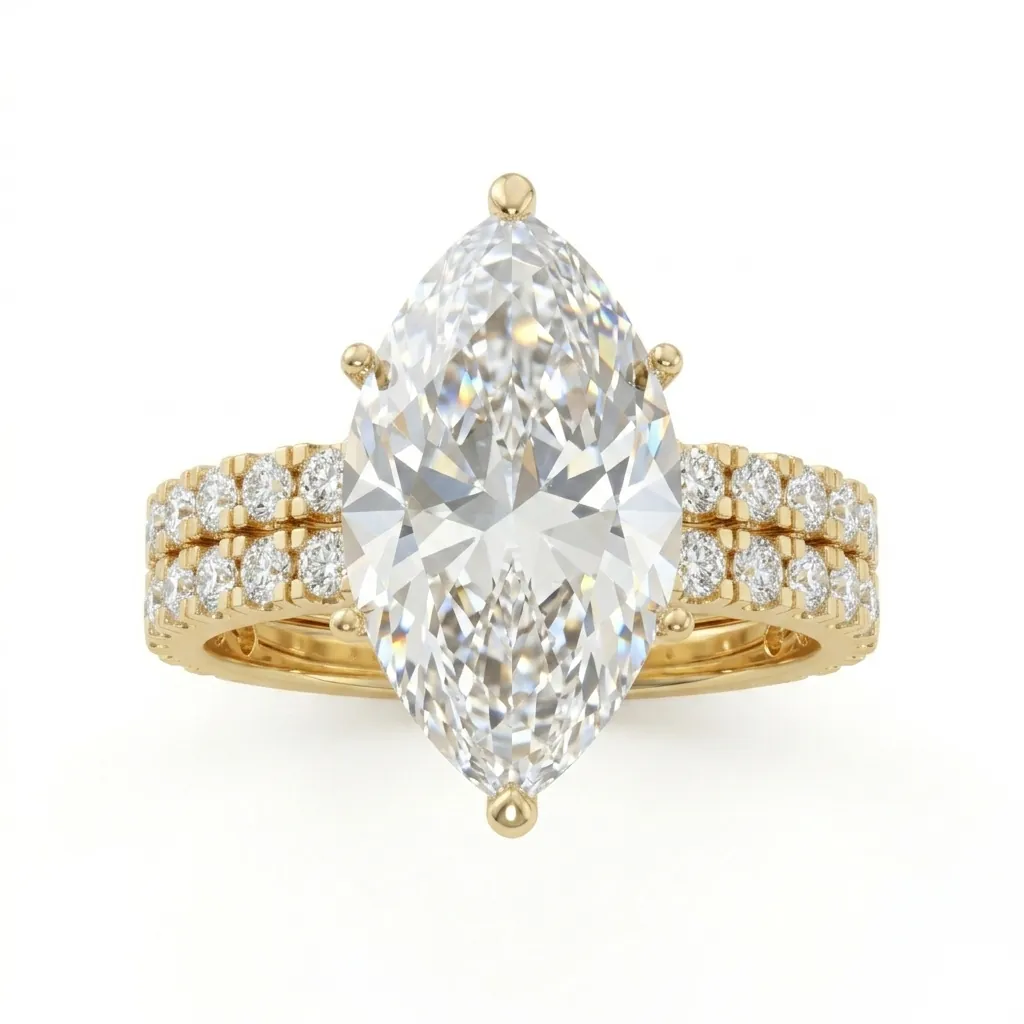 Starting photo
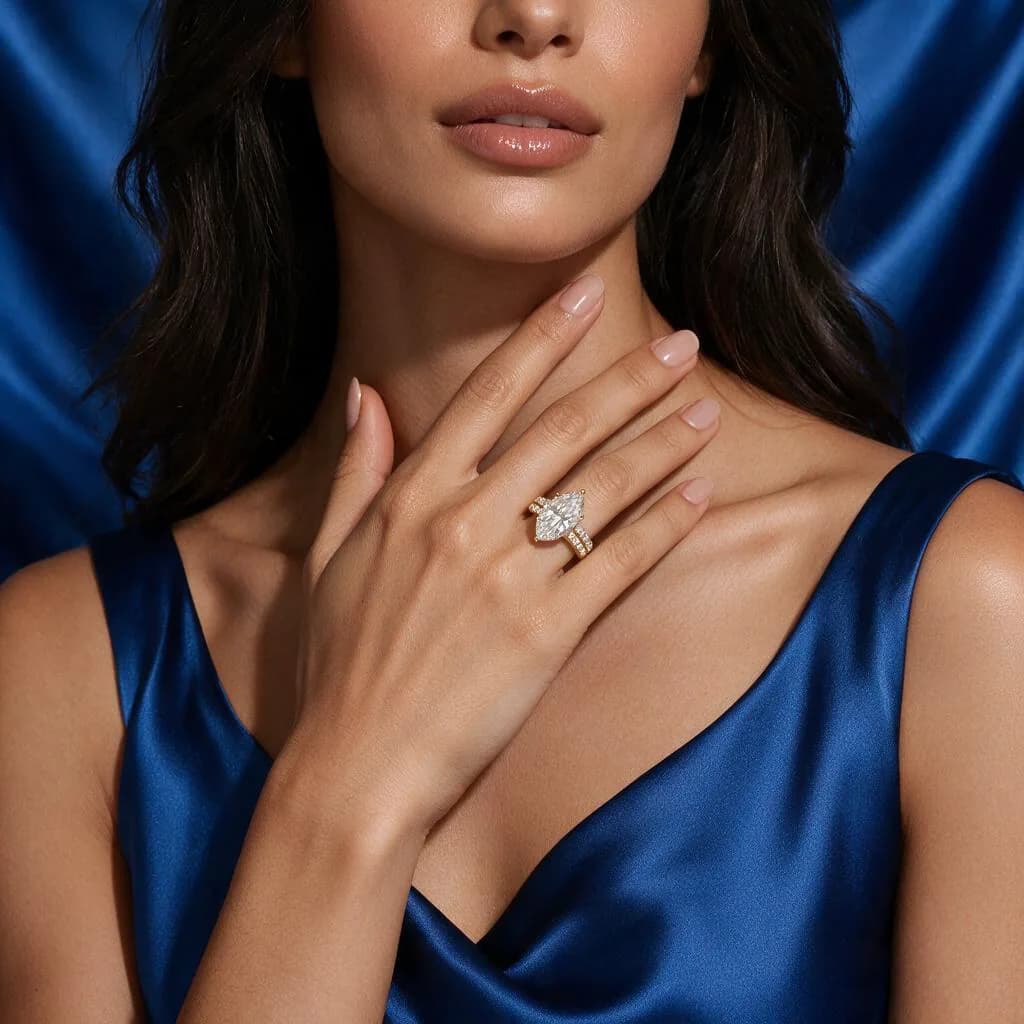 Made with Hues
Before you pay: receipts, returns and engraving
- Ask for a gift receipt, and check that the return or exchange window runs past the day the gift will be opened.
- Ask whether the first resize is free, and how long it takes.
- Leave engraving until after the gift is opened if you can. Engraved pieces are often harder or impossible to return.
- Keep the box, certificate and any paperwork: a diamond or gemstone grading report belongs with the gift.